


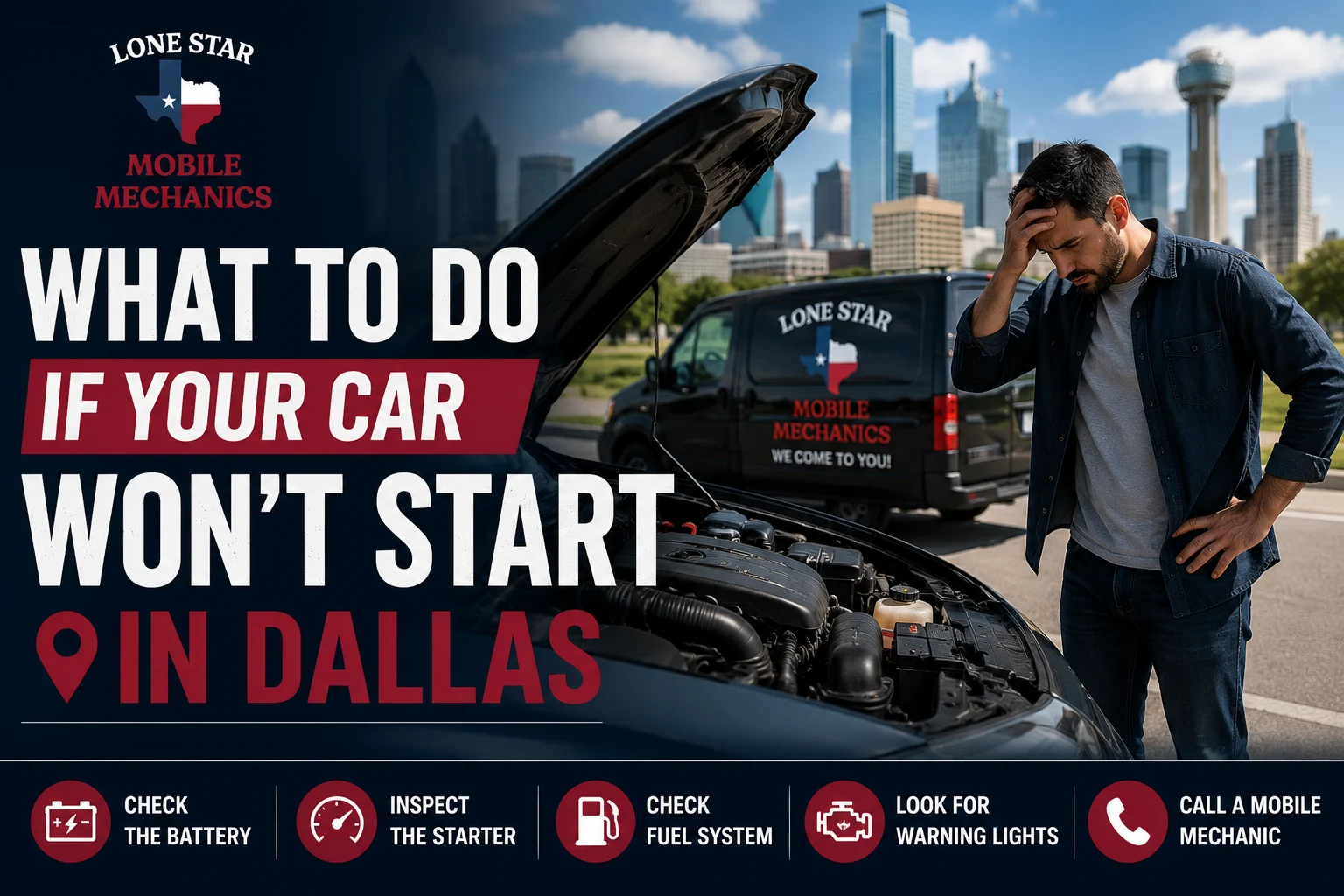
What To Do If Your Car Won’t Start in Dallas
You turn the key, press the button, and… nothing. Maybe a click. Maybe total silence. A car that won’t start is one of the most stressful situations a Dallas driver can face, especially if you’re running late for work, sitting in a Target parking lot, or stranded on I-35E during rush hour. The good news: most no-start problems come down to a short list of common causes, and many of them can be diagnosed in minutes without ever calling a tow truck.
Here’s exactly what to do, step by step, when your car won’t start anywhere in Dallas, Fort Worth, or the surrounding DFW area.
Step 1: Listen Before You Panic
What your car does (or doesn’t do) when you turn the key tells you almost everything you need to know.
- You hear a rapid clicking sound. This is the classic sign of a weak or dead battery. The starter motor isn’t getting enough power to turn the engine over, so it just clicks instead.
- You hear nothing at all — no click, no light, total silence. This usually points to a completely dead battery, a corroded or loose battery terminal, or in some cases a blown fuse or bad ignition switch.
- The engine cranks but won’t catch. This is different from a battery issue. Cranking means the starter is working and the battery has enough charge — the problem is more likely fuel delivery, a failing fuel pump, or a spark/ignition issue.
- You hear a single loud clunk. This can indicate a failing starter motor or a problem with the starter solenoid.
- Dashboard lights and radio work fine, but the engine won’t turn over. This is often a bad starter, a faulty neutral safety switch (automatic transmissions), or in rare cases, an immobilizer/key fob issue.
Knowing which category your car falls into helps you (or your mechanic) skip straight to the fix instead of guessing.
Step 2: Check the Easy Stuff First
Before assuming the worst, rule out the simple causes:
Make sure the car is actually in Park (automatic) or that the clutch is fully depressed (manual) — safety switches will block the starter otherwise. Check that no interior lights, phone chargers, or accessories were left on overnight, which can drain a battery in a single cold or hot night. Look at the dashboard for warning lights like a battery icon, check engine light, or security/immobilizer light. Pop the hood and visually check the battery terminals for white, green, or blue corrosion buildup, and check that both cable clamps are tight on the posts.
If the terminals are corroded, that alone can cause a no-start even with a perfectly good battery, since corrosion blocks the electrical connection.
Step 3: Try a Jump Start (If You Have Help)
If clicking or silence points to a battery issue and you have jumper cables and another vehicle, a jump start is worth trying:
Connect the red clamp to the dead battery’s positive terminal, then the other red clamp to the donor battery’s positive terminal. Connect the black clamp to the donor battery’s negative terminal, then the final black clamp to an unpainted metal surface on the dead car’s engine block — not the dead battery’s negative post. Start the donor vehicle and let it run for a couple of minutes, then try starting your car.
If the car starts after a jump but the battery dies again within a day or two, that’s a strong sign the battery itself needs to be replaced rather than just recharged, especially if it’s three years old or more — which is common in Texas, where extreme summer heat shortens battery lifespan significantly.
Step 4: Know When It’s Not the Battery
If the engine cranks normally but won’t fire up, or if jumping the battery doesn’t change anything, the issue is likely elsewhere: a clogged fuel filter, failing fuel pump, bad ignition coil, faulty starter, or even a security system glitch. These problems aren’t something most drivers can diagnose from the driveway, and they’re exactly where a mobile mechanic earns their keep — bringing diagnostic tools straight to your location instead of you guessing or paying for an unnecessary tow.
Step 5: Decide Between a Tow and a Mobile Mechanic
Here’s where most Dallas drivers waste time and money: calling for a tow truck before confirming whether the car actually needs to leave its current location.
In the vast majority of no-start situations — dead battery, corroded terminals, bad starter, weak alternator — the repair can be done right where the car is sitting. There’s no mechanical reason to tow a car to a shop just to get a new battery installed. A mobile mechanic comes to your home, office parking lot, or roadside location, tests the battery and charging system on the spot, and installs a replacement battery from a stocked van if needed — all without you ever touching a tow truck.
This matters even more in DFW traffic. Towing adds a wait for the truck, a ride or rideshare to the shop, and then a wait for the repair — easily a half-day ordeal for what might be a 20-minute battery swap.
Step 6: Get the Right Help, Fast
If you’re stuck anywhere across Dallas, Fort Worth, Plano, Frisco, McKinney, Carrollton, Richardson, Addison, Lewisville, The Colony, Aubrey, or the surrounding DFW area, Lone Star Mobile Mechanics can come straight to you. The team tests your battery and charging system on-site, and if a car battery replacement is needed, it’s installed right then and there from a fully stocked mobile van — no towing, no shop wait, no guesswork.
Common situations handled on the spot include:
A dead or dying battery that won’t hold a charge, corroded or damaged battery terminals and cables, a failing alternator that’s draining the battery repeatedly, and a worn-out starter motor that clicks but won’t engage.
With over 25 years of experience and mobile battery replacement service across more than 30 DFW cities, help typically arrives within 1–2 hours of your call, with an honest quote given before any work begins.
Don’t Get Stuck Guessing
A car that won’t start is frustrating, but it’s rarely a mystery once you know what to listen for. Check the basics, try a jump if it’s safe to do so, and if the problem points to the battery or charging system, skip the tow truck altogether.
Stranded in Dallas–Fort Worth? Call or text Lone Star Mobile Mechanics at +1(214) 551-4796 for fast, on-site battery testing and replacement.
Frequently Asked Questions
Why does my car just click when I try to start it?
A rapid clicking sound when you turn the key almost always points to a weak or dead battery. The starter motor isn’t receiving enough power to turn the engine over, so it clicks instead of cranking. Corroded or loose battery terminals can cause the same symptom even if the battery itself is fine, so it’s worth checking the connections before assuming you need a full replacement.
Should I jump-start my car or call a mobile mechanic?
If you have jumper cables and another vehicle handy, a jump start is a reasonable first try for a battery-related no-start. But if the car dies again within a day or two, or you don’t have a second vehicle available, it’s faster and safer to call a mobile mechanic. They can test the battery and charging system on-site and install a replacement immediately if needed, without the hassle of finding a donor car.
Do I need to tow my car if the battery is dead?
No. In the vast majority of no-start situations — a dead battery, corroded terminals, a weak alternator, or a failing starter — the repair can be completed right where the car is parked. Towing is unnecessary for a standard battery replacement, and a mobile mechanic can install a new battery from a stocked van wherever you’re stranded.
How do I know if it’s the battery or something else, like the starter or alternator?
If you hear clicking or get total silence, it’s typically the battery or its connections. If the engine cranks normally but won’t fire up, the issue is more likely fuel delivery or ignition-related rather than the battery. A single loud clunk often points to a failing starter, while a battery that keeps dying even after a jump usually signals a failing alternator. A technician can confirm with a quick on-site diagnostic test.
How long does a mobile car battery replacement take in Dallas?
Most mobile battery replacements take around 20 to 30 minutes once the mechanic arrives. In most DFW cities, a technician can typically reach you within 1–2 hours of your call, and the entire visit — testing, replacement, and verification — is usually finished in a single stop with no towing or shop wait involved.
Call us Now for Expert Car Battery Replacement in Dallas, TX – +1(214) 551-4796